
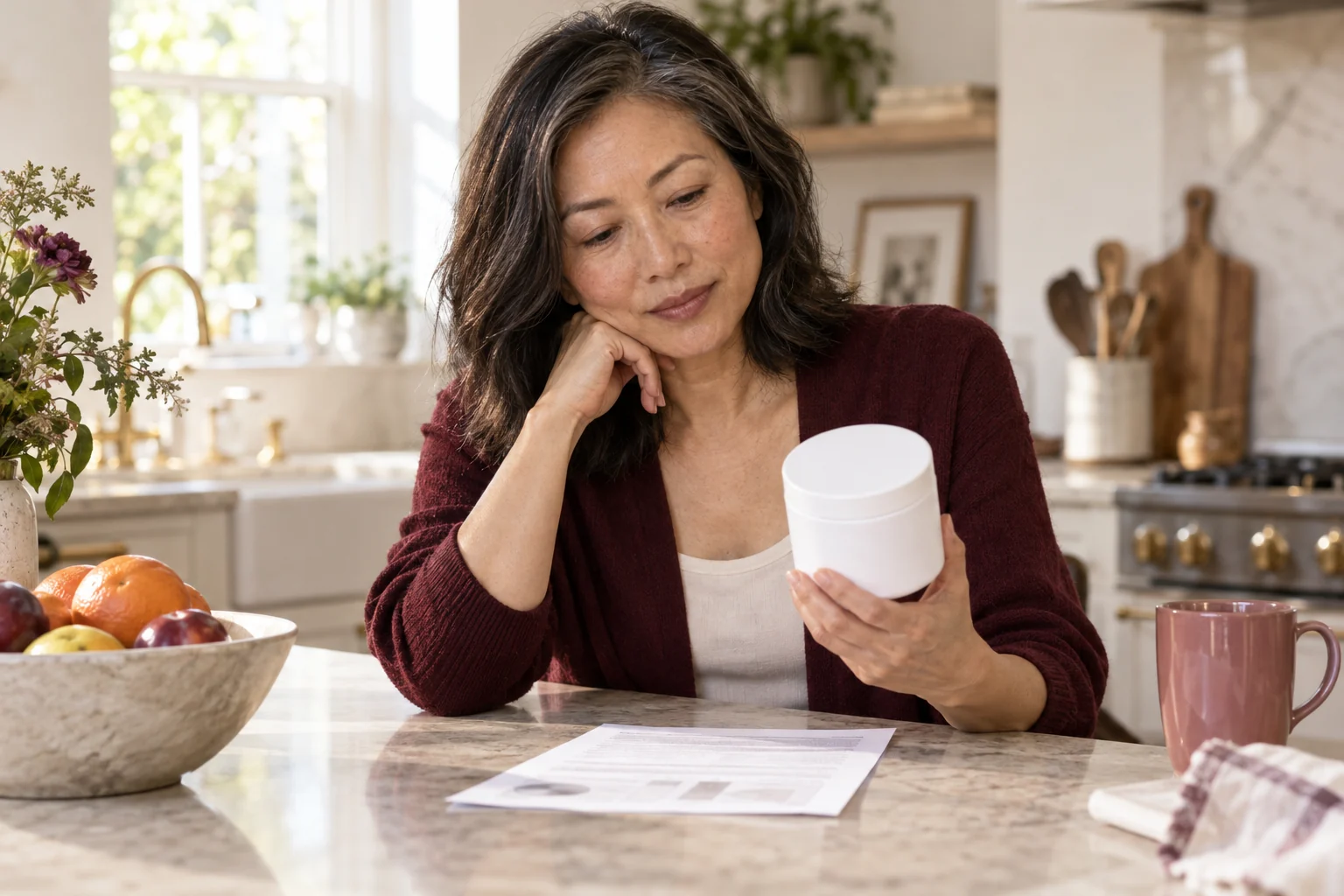
Before buying collagen for appearance changes during GLP-1 treatment, ask which change the evidence measures.
What one original trial tested
In a 2014 double-blind trial, 69 women aged 35–55 received 2.5 or 5 grams of specific collagen peptides daily, or placebo, for eight weeks. The abstract reports improved elasticity in both collagen groups; moisture and skin-evaporation subgroup findings were not statistically significant. Those studied amounts are not a personal dosing recommendation. [1]
The abstract does not describe a GLP-1 group or cheek-volume outcome. Findings for specific peptides do not transfer automatically to another formulation.
Why reviews need scrutiny too
A 2025 review of 23 randomized trials with 1,474 participants found positive pooled skin outcomes. However, its high-quality study groups and groups without pharmaceutical-company funding showed no significant benefit for hydration, elasticity or wrinkles. That makes study quality and funding relevant to a purchasing claim. [2]
A July 2026 review reached a more favorable conclusion about hydration and elasticity, but found structural outcomes such as wrinkles uncertain after further analyses. Formulations, measurements and trial durations differed. The reviews do not supply a GLP-1-specific recovery plan. [3]
Separately, a September 2026 audit of 2021 and 2023 meta-analyses identified data-reporting errors and inappropriate combinations of skin measurements. Its dose-adjusted reanalysis found no evidence of benefit. This was an evidence audit, not a new GLP-1 treatment trial. [5]
Bring the product and the claim
FDA does not approve dietary supplements for safety and effectiveness before marketing. It advises discussing a supplement with a doctor, pharmacist or other qualified clinician before buying or using it. [4]
Bring the ingredient label. Ask which trial tested that formulation, who participated, which outcome changed and who funded it.
The studies concern skin parameters; the regulatory advice is US-specific. For a topical appearance question, read our firming-cream evidence guide.

Printed book
How to Keep Your Face on GLP-1
$12.95 + free shipping
Order Now30 day money back guarantee
This article provides general education, not a diagnosis or an individual treatment plan. Medication information refers to US sources. Discuss medication, nutrition and cosmetic treatment decisions with qualified clinicians.
Read next
Nails & careBrittle Nails on GLP-1: Review Your Manicure Routine→Skin & preparationConsidering a Chemical Peel During GLP-1 Treatment?→Sources
- Oral supplementation of specific collagen peptides has beneficial effects on human skin physiology: a double-blind, placebo-controlled studyProksch et al., Skin Pharmacology and Physiology, 2014; original trial abstract via PubMed↩ Back to text
- Effects of Collagen Supplements on Skin Aging: A Systematic Review and Meta-Analysis of Randomized Controlled TrialsMyung and Park, The American Journal of Medicine, 2025↩ Back to text
- Oral Collagen Peptides and Skin Rejuvenation: A Systematic Review and an Updated Meta-Analysis of Randomized Controlled TrialsBatool et al., Journal of Cosmetic Dermatology, July 2026↩ Back to text
- Information for Consumers on Using Dietary SupplementsUS Food and Drug Administration↩ Back to text
- Hydrolyzed Collagen for Skin Aging Meta-Analyses Are UnreliableGrimes and Mahto, Journal of Cosmetic Dermatology, September 28, 2026↩ Back to text