
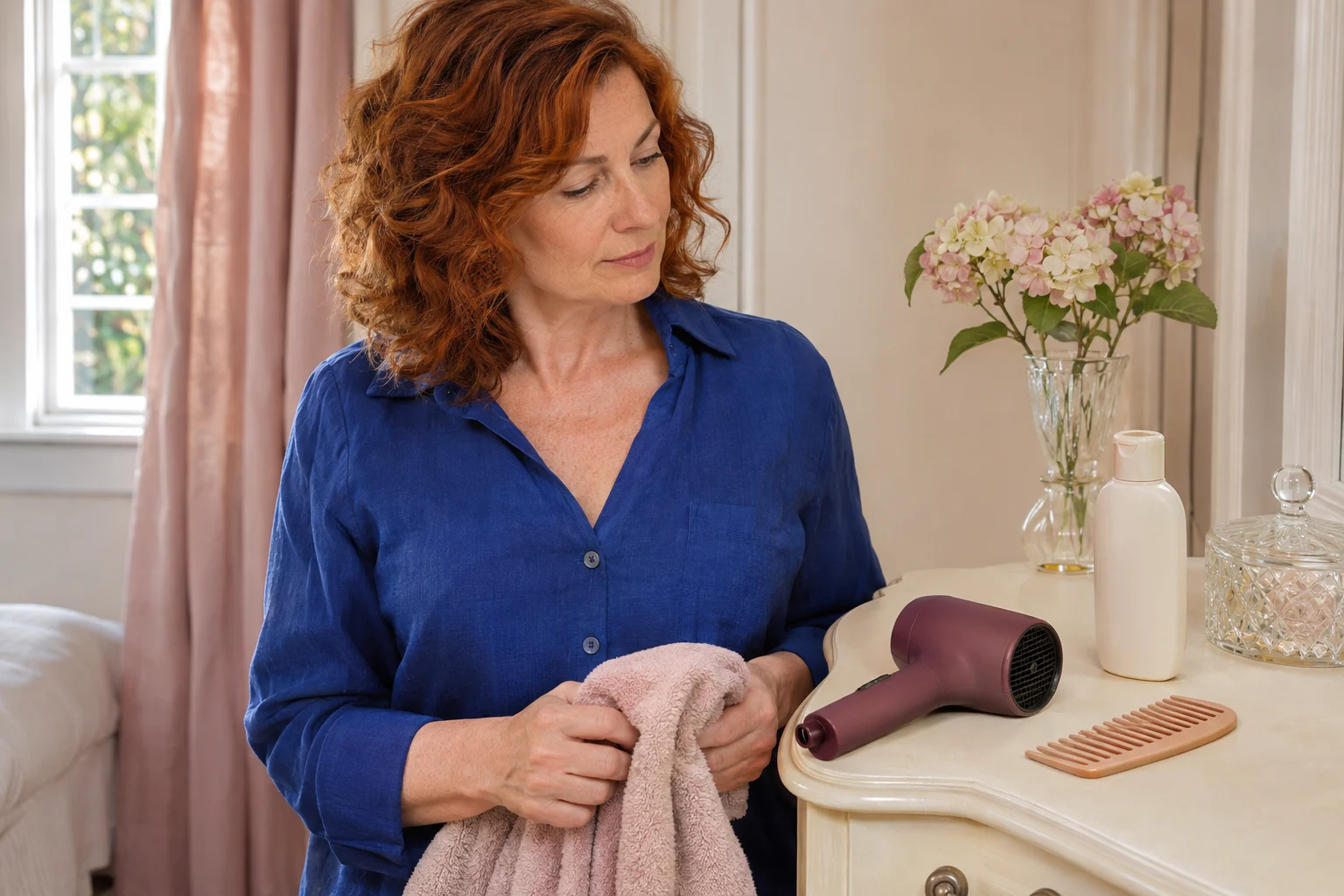
If your hair feels fragile during GLP-1 treatment, a claim that blow-drying is safer than air-drying may catch your attention. A frequently cited experiment examined detached hair strands under microscopes. Its findings need the tested conditions beside them.
The dryer distance changed along with temperature and time
At 15 centimeters, drying lasted sixty seconds at 47°C; at 10 centimeters, thirty seconds at 61°C; at 5 centimeters, fifteen seconds at 95°C. Other groups were untreated or air-dried at 20°C after shampooing. Temperatures were measured near the samples. [1]
Distance, temperature and time changed together. The design cannot isolate their individual effects.
The surface and inner structures showed different findings
Surface damage increased with heat. No cortex damage was seen. Only air-dried samples showed cell membrane complex damage between hair cells; these took over two hours to dry. Moisture differences were not significant. [1]
A “less damage” headline needs the examined structure beside it. It cannot establish a universally safer method.
Use the broader care guidance when planning your routine
AAD recommends air-drying when possible, choosing the lowest heat setting when using heat tools and using those tools less often. It also advises absorbing water with a towel rather than rubbing and using conditioner after every shampoo. [2]
Combing advice depends on texture. AAD suggests letting straight hair dry somewhat before gently using a wide-tooth comb. For textured hair or tight curls, it recommends wide-tooth combing while damp. A method that helps detangle one hair type should not automatically be copied to another. [2]
Show your stylist the dryer, brush and products you normally use. Describe where hair snags, how long styling takes and whether you repeatedly heat one section. Ask for a lower-heat routine that you can manage without forceful brushing or pulling.
Have shedding assessed separately
AAD explains that a hair-loss assessment includes how quickly the change began, examination of the scalp and testing whether strands are prone to breaking. Depending on the suspected cause, blood testing or a scalp biopsy may be considered. Finding the cause guides treatment. [3]
For routine preparation, use the heat-tool discussion guide. For the medical assessment, read the hair-shedding plan.
Printed book
How to Keep Your Face on GLP-1
$12.95 + free shipping
Order Now30 day money back guarantee
This article provides general education, not a diagnosis or an individual treatment plan. Medication information refers to US sources. Discuss medication, nutrition and cosmetic treatment decisions with qualified clinicians.
Read next
Hair & nailsBiotin on GLP-1: Hair, Nails and Blood-Test Questions→Hair & nailsBrittle Nails: Read the Lacquer and Biotin Comparison→Sources
- Hair shaft damage from heat and drying time of hair dryerLee and colleagues, Annals of Dermatology, 2011; full primary paper↩ Back to text
- How to stop damaging your hairAmerican Academy of Dermatology↩ Back to text
- Hair loss: Diagnosis and treatmentAmerican Academy of Dermatology↩ Back to text