
Before your next gel manicure during GLP-1 treatment, look closely at the nail-lamp research behind a safety claim. Two cell studies show why exposure schedule and laboratory conditions belong beside the findings. Neither counted cancers among manicure clients.
The 2023 exposures lasted twenty minutes at a time
One protocol used two twenty-minute exposures separated by an hour. Another used twenty-minute exposures on three consecutive days. The cell systems lacked the skin's outer cornified layer, one limitation the authors identified when considering how the findings might translate to people. [1]
My interpretation is that the experiment identifies a biological concern, while leaving the size of a client's risk unanswered. A percentage of cells dying in a dish cannot be relabeled as the percentage of manicure customers who will develop cancer.
The later experiment examined heat and position
Finn and colleagues' 2024 study tested cultured human keratinocytes and dermal fibroblasts using a commercial UV-LED nail dryer. Its shorter salon-model schedule used six thirty-second exposures with two-minute intervals. It also tested the longer exposure schedules. [2]
UVA output varied with location inside the unit. The researchers found that heat could magnify the damaging effects in their experimental setup. Under the shorter schedule, keratinocytes showed no reduction in viability, while fibroblasts did show reduced viability. Those are different cell responses, not an all-clear result for every tissue. [2]
The authors disclosed that Peter Sykora was chief scientific officer and director of Amelia Technologies; they stated that the involved entities had no commercial interest in UV nail devices. [2]
Six thirty-second exposures total three minutes. That is a protocol comparison, not a universal safe-time allowance. Neither cell study establishes GLP-1-specific risk.
Use the dermatology guidance at the appointment
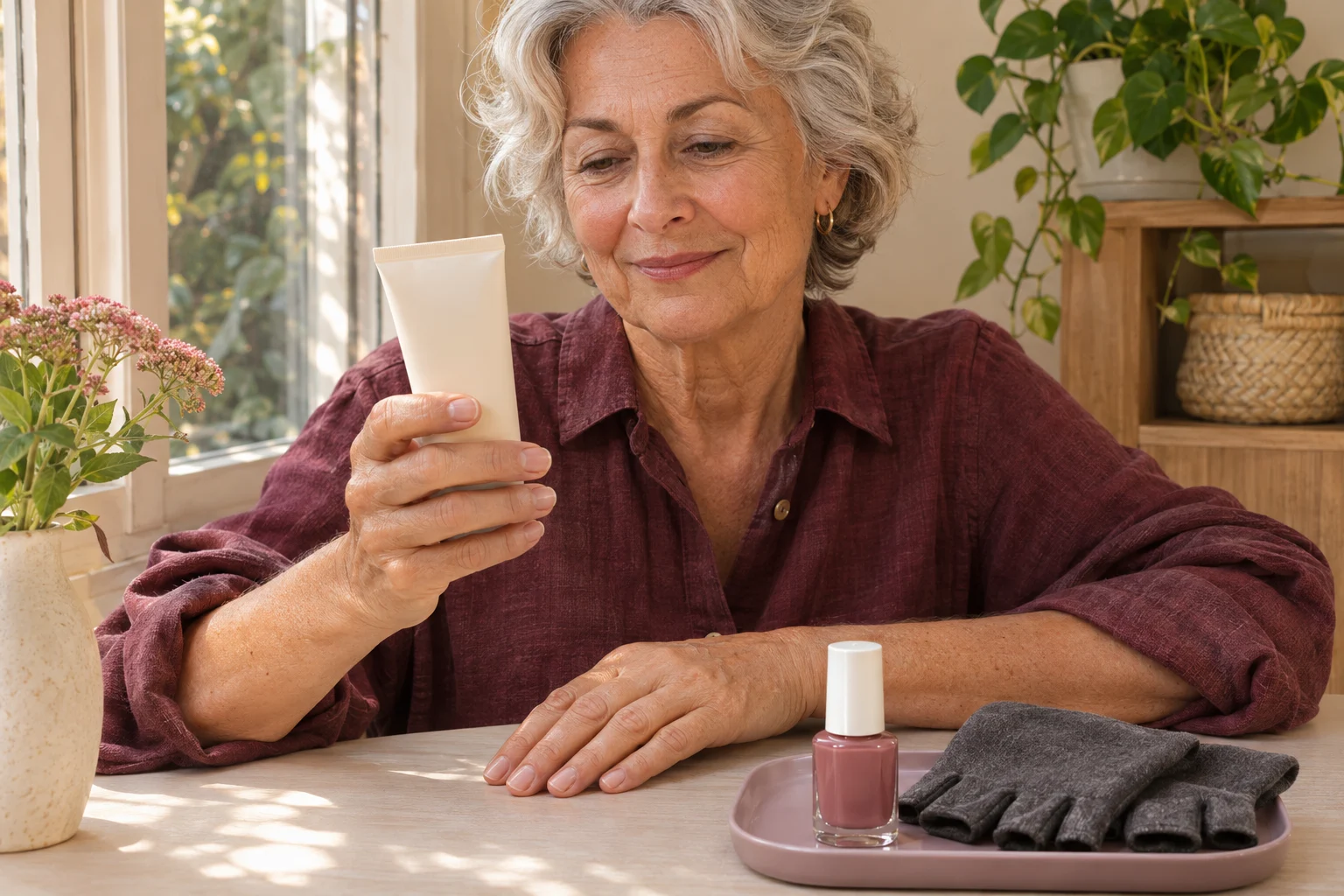
AAD recommends applying broad-spectrum, water-resistant SPF 30 or higher sunscreen to the hands before a gel manicure. An alternative is dark, opaque gloves with the fingertips cut off, put on before polish application. It also suggests considering traditional polish, especially for recurring nail problems. [3]
Decide on hand protection before you arrive and tell the technician what you plan to use. Ask which service requires a curing lamp and follow the product and device instructions. If you prefer to avoid a lamp, ask about a traditional-polish service.
AAD also recommends a dermatologist for unusual nail changes or persistent nail problems. A change in the nail or nearby skin deserves assessment rather than repeated coverage. [3]
For preparation and removal concerns, see the brittle-nail manicure guide. For a lifted or discolored nail, read what to have assessed before covering it.

Printed book
How to Keep Your Face on GLP-1
$12.95 + free shipping
Order Now30 day money back guarantee
This article provides general education, not a diagnosis or an individual treatment plan. Medication information refers to US sources. Discuss medication, nutrition and cosmetic treatment decisions with qualified clinicians.
Read next
Hair & nailsBiotin on GLP-1: Hair, Nails and Blood-Test Questions→Hair & nailsBrittle Nails: Read the Lacquer and Biotin Comparison→Sources
- DNA damage and somatic mutations in mammalian cells after irradiation with a nail polish dryerZhivagui and colleagues, Nature Communications, 2023; primary paper↩ Back to text
- Temperature is a key factor governing the toxic impact of UVR-emitting nail dryers when used on human skin cellsFinn and colleagues, International Journal of Toxicology, 2024; primary paper↩ Back to text
- Gel manicures: Tips for healthy nailsAmerican Academy of Dermatology↩ Back to text