
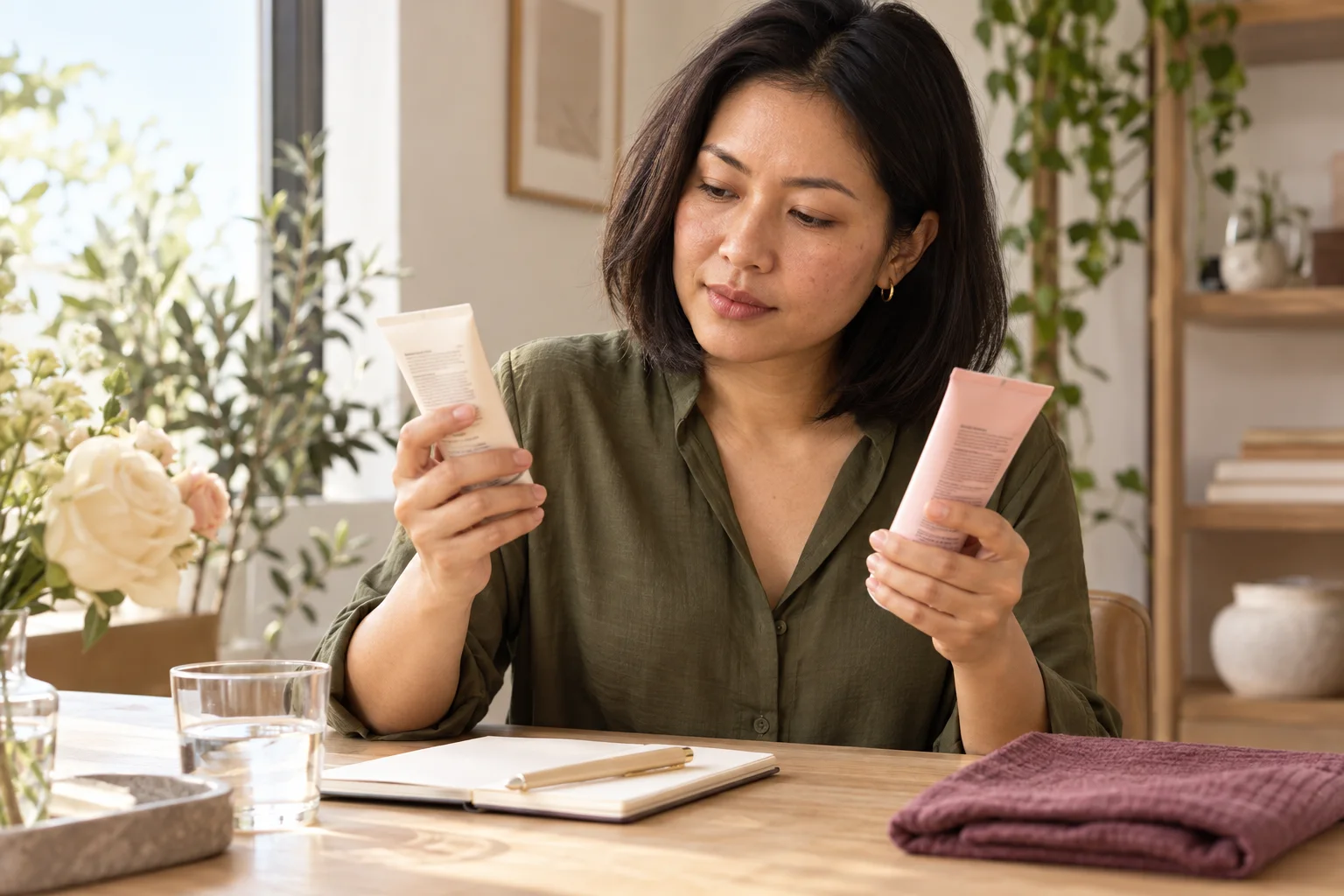
If you are managing acne as well as appearance concerns during GLP-1 treatment, ask what each part of your skincare routine is intended to do. A moisturizer claim needs a specific outcome and a comparison before it can guide a purchase.
What did the split-face trial test?
Triwatcharikorn and colleagues studied 40 Asian adults, including 31 women, for four weeks. Each used Eucerin Adjunctive Soothing Care on one side and a hospital hydrophilic cream base on the other. Thirty received adapalene/benzoyl peroxide and ten oral isotretinoin. The tested moisturizer combined 4-t-butylcyclohexanol, licochalcone A, ceramide and panthenol. [1]
Hydration and patient-reported dryness favored the tested product. However, the overall between-side difference in transepidermal water loss, a measure of water escaping through skin, was not significant (P=0.983). Redness and acne-lesion changes also did not differ significantly between sides. [1]
Beiersdorf Thailand funded the study; the authors declared no conflicts. The small, short study compared whole formulations, so it cannot isolate one ingredient's contribution. It did not test GLP-1-related facial volume or establish an interaction with those medicines. The publisher's PDF is an early manuscript version. [1]
Decide what the moisturizer is for
AAD explains that benzoyl peroxide, salicylic acid, topical retinoids and isotretinoin can dry and irritate skin. Daily moisturizer can help with tolerability. For acne-prone skin, it suggests looking for oil-free, non-comedogenic or “won't clog pores” descriptions. [2]
Ask the person reviewing your routine to name the intended purpose: reducing dryness, improving comfort or another goal. If a product is advertised with several benefits, ask which evidence supports the one you care about. Bring the full label, including ingredients and directions, rather than only the front of the package.
Describe what bothers you in terms you can check again at the review: visible flaking beside the mouth, tightness after washing or discomfort after a particular step. Include when it began and which products were added or changed around that time. These observations organize the discussion; they do not identify the cause.
Fit it into the actual treatment plan
Write down the exact acne medicine, strength, formulation and current directions. Include cleanser, moisturizer, sunscreen and any other products used on the same area. Ask the prescriber or pharmacist to explain where a proposed moisturizer fits and whether anything else in the routine needs review.
AAD recommends moisturizing dry acne-prone skin daily and notes that applying moisturizer after washing helps retain water. It also advises a dermatologist's assessment when you are unsure how moisturizer fits acne care. [2]
Follow the instructions given for your prescription and ask about anything that appears inconsistent with a general skincare suggestion. Do not change a medicine's dose, frequency or route to reproduce a research routine. Our dry and flaky skin routine guide covers preparing a product list and describing changes for a review.
Check tolerance before adding a product
AAD's home-testing guidance suggests a quarter-sized spot on the underside of the arm or elbow bend, twice daily for seven to ten days, using the usual amount and contact time. If a reaction develops, gently wash the product off and stop using it. Severe reactions not relieved by simple measures need dermatologic advice. [3]
Ask your treating team whether that approach is appropriate for the product you are considering and your current skin condition. A home use test does not replace medical patch testing to investigate an allergy. AAD advises discussing persistent uncertainty about a reaction's cause with a dermatologist. [3]
Keep the product name and the date of any reaction available for that conversation. If several products are involved, bring all of them. Avoid calling an uncomfortable response proof that an ingredient is working.
Prepare a focused review
Ask which outcome the clinician wants you to monitor, when to return and how to report a problem before then. Keep the instructions with the product list so you can explain what you used and what happened.
- What is this product intended to change in my routine?
- How should it fit my current prescriptions and other skincare?
- Which symptoms should I report, and who will review them?
These questions are editorial aids, not a tested treatment program. If your main concern is an appearance change during GLP-1 treatment, describe that concern directly to the clinician managing your care. A moisturizer study should not decide a medication change.

Printed book
How to Keep Your Face on GLP-1
$12.95 + free shipping
Order Now30 day money back guarantee
This article provides general education, not a diagnosis or an individual treatment plan. Medication information refers to US sources. Discuss medication, nutrition and cosmetic treatment decisions with qualified clinicians.
Read next
Skin careAcne Scars During GLP-1: Identify the Mark Before Treatment→Skin & researchAdapalene for Photoaging: Check the 0.3% Trial and the Acne Label→Sources
- Triwatcharikorn and colleagues: Moisturizers during acne treatmentDermatology Reports; March 27, 2026; full early manuscript↩ Back to text
- Moisturizer: Why you may need it if you have acneAmerican Academy of Dermatology; checked October 31, 2026↩ Back to text
- How to test skin care productsAmerican Academy of Dermatology; updated August 10, 2021; checked October 31, 2026↩ Back to text